
Interactive Guide
The Principles of Good Lighting
Good lighting is not about buying fittings. It is about delivering the right light, in the right place, for the lowest lifetime cost.
- 01
How much light do I need?
- 02
How do I create it efficiently?
- 03
How do I ensure quality?
- 04
How do I protect the investment?
- 05
How do I minimise lifetime cost?
The Principles of Good LightingSection 1 · What We Do
Energy LED Helps Businesses Achieve The Right Lighting
Not too much. Not too little. We help businesses achieve lighting systems that perform for the people who work under them and the finance team that pays for them.
Meet legal lighting standards
Improve workplace safety
Improve productivity
Reduce energy consumption
Reduce maintenance costs
Deliver long-term value
Our goal is simple
Provide the right light, in the right place, for the lowest total cost over its lifetime.
Positioning Energy LED as a trusted advisor changes the discussion from unit price to total cost of ownership. A facility manager cares about compliance and safety, an engineer about performance data, procurement about price, and the financial decision-maker about payback. The principles approach answers all four with the same design.
The Principles of Good LightingPrinciple #1
How Much Light Do You Need?
Lighting is not determined by opinion. In South Africa the Occupational Health and Safety Act prescribes minimum lighting levels for different work environments. A warehouse, for example, requires 150–200 , and the design must allow for the so it still complies in year ten.
Measured on the working plane
0lux
Measurement, not opinion. Lux levels are verified on site against the standard for the task performed.
Warehouse aisles
150–200 lux
Safe movement, racking navigation and stock identification.
In South Africa these are legal minimums, set by the Occupational Health and Safety Act (Environmental Regulations for Workplaces).
Too little light: unsafe and unproductive.
Too much light: wasted energy and money.
Lux checker
What does this space legally need?
Legal range
150–200
lux, OHS Act
Maintenance factor
0.70
Normal industrial
Day 1 design target
215
lux, so it still complies at end of life
General storage and racking aisles. Design lux equals the required lux divided by the maintenance factor, which is why a system designed to exactly the legal minimum on Day 1 falls out of compliance.
The first step is determining the correct light level required for the task being performed.
- • Identify each task area and the visual difficulty of the work performed there.
- • Reference the OHS Act minimum for that environment, plus any client or insurer requirement.
- • Take on-site lux readings across the working plane, not just under the fittings.
- • Model the space so the design target is maintained at the end of life, not only on Day 1.
- • Document the design so compliance can be demonstrated during audits or inspections.
The Principles of Good LightingRun the numbers
What Would This Save You?
Enter the site's real numbers and see the annual saving, the payback period and the carbon avoided. Change any input and the answer updates live.
Your numbers
Indicative only. A site survey and lighting design confirm the fitting count, wattage and layout before any figure is quoted.
Annual electricity saving
R325 728
112 320 kWh saved every year
8
months to payback
R3 035 280
net 10 year position
107 t
CO2 avoided per year
The Principles of Good LightingPrinciple #2
How Efficiently Can We Create That Light?
Once we know how much light is needed, the next question becomes: how much electricity does it take to create that light?
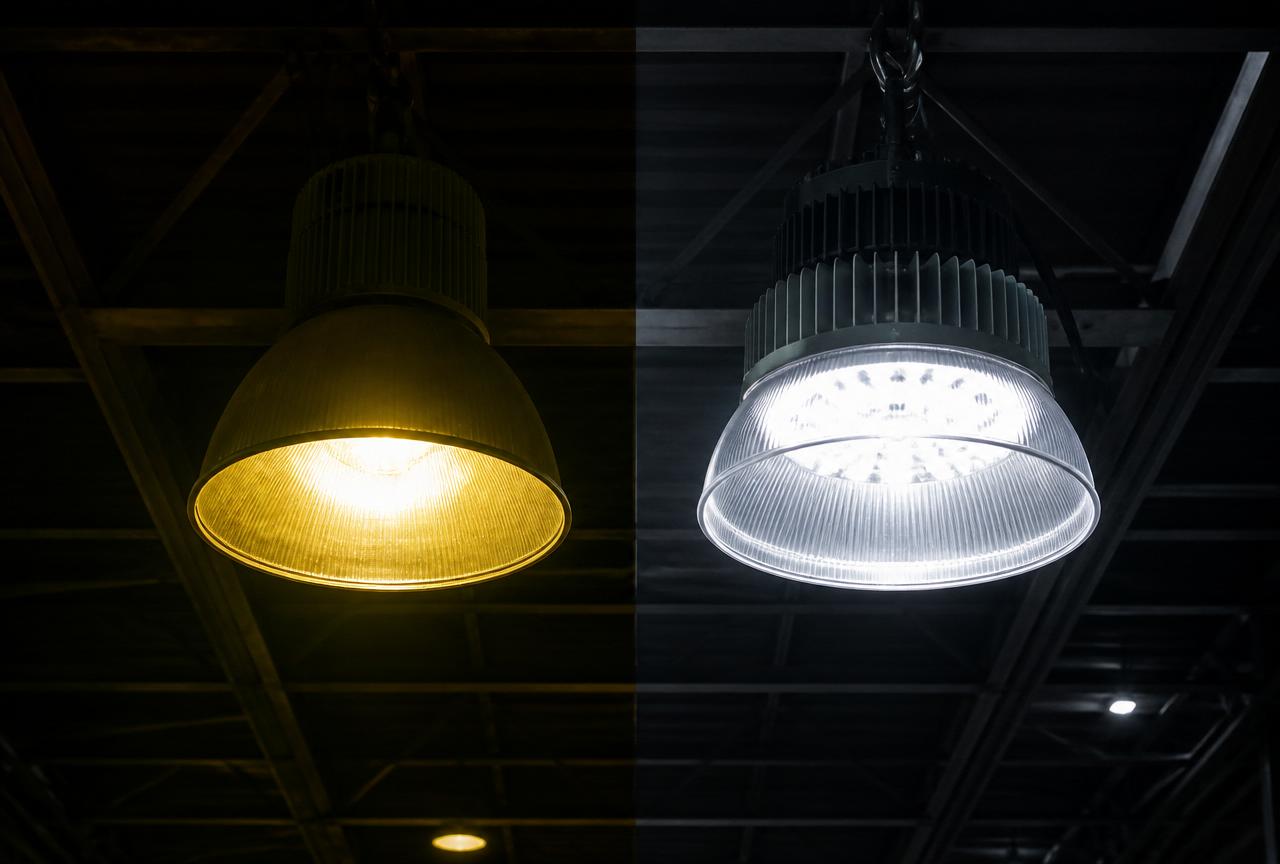
Same light output · 1 000 lumens
Traditional technology
150W
Modern LED
50W
Identical light on the floor for roughly a third of the electricity, the saving repeats every hour the lights are on.
Better efficiency = Lower electricity costs
The most efficient lighting systems produce the required light using the least amount of energy.
South African reality
≈ 1 100%
Electricity tariffs have increased by approximately 1 100% since 2007. Every watt saved matters, and keeps compounding every year the tariff rises again.
- • Luminaire efficacy (), how much light each watt produces at the fitting.
- • Optical delivery, how much of that light actually lands on the task plane.
- • Layout and mounting height, the wrong spacing wastes both light and energy.
- • Controls, occupancy sensing and daylight harvesting remove burn hours entirely.
- • Maintained output, a fitting that fades fast forces over-lighting from Day 1.
The Principles of Good LightingSection 4 · Not All Light Is Equal
Quality Matters
Two systems can deliver identical lux readings and still feel completely different to the people working beneath them. Click each panel for the detail.
Live demo
Flicker
Quality driver, flicker free
Flicker comes from the driver, not the LED. It causes eye strain, headaches and reduced concentration, and it makes rotating machinery appear stationary.
Live demo
Glare
Diffused optics, light on the task
Glare puts light in the eye instead of on the task. Good optics push the light down onto the working plane and keep the source out of the line of sight.
The Principles of Good LightingSection 5 · Light Fades Over Time
All Lighting Depreciates
All lighting technologies lose brightness as they age. This is known as lumen depreciation.
Smart Lighting Design Plans For The Future
If a lighting system is designed to provide exactly the required light level on Day 1, it may fall below legal requirements a few years later. A professional lighting design allows for expected depreciation over time, typically designing with approximately 30–50% additional light output initially, so the required levels are maintained throughout the life of the installation.
The allowance is not guesswork. It combines the luminaire's own lumen maintenance (L70/ at rated hours), luminaire dirt depreciation for the environment, room surface depreciation and expected cleaning intervals. A dusty foundry and an air-conditioned electronics plant get different factors, which is why a design copied from another site rarely holds up.
Legal minimum (warehouse)
150 lux
Day 1 design output (+30–50%)
195 lux
Year 5 output
still 150 lux
Year 10 output
still 150 lux
Designed, not guessed
A well-designed installation still hits its target lux in year seven, because the depreciation was designed in on day one.
The Principles of Good LightingSection 6 · Not All LED Fittings Are Created Equal
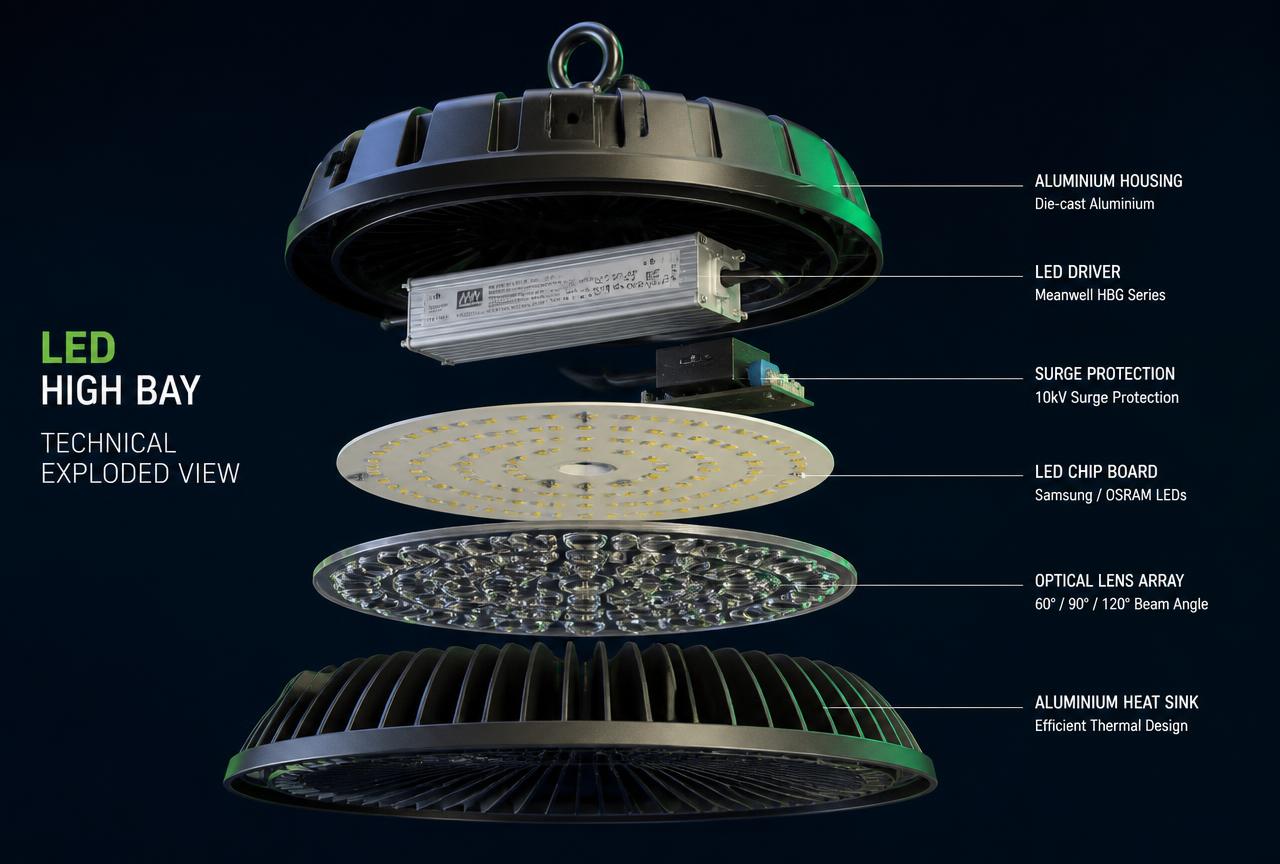
The Luminaire Matters
A luminaire is much more than an LED chip. Click each component to see what performance actually depends on.
 The Principles of Good Lighting
Section 7 · South African Reality
Surge Protection Matters
South Africa's electrical network experiences frequent voltage spikes, switching transients, lightning-induced surges and load restoration events. These transient voltages can permanently damage LED drivers and electronic components.
The Hidden Risk
Many buyers assume that a warranty covers all failures. In reality, most lighting manufacturers specifically exclude surge damage from their warranties. Surge events are generally regarded as external electrical events rather than product defects.
Ask to see the warranty document, then find the exclusions clause. It is a five-second check that reframes the whole price comparison: an unprotected fitting is effectively uninsured against the single most common cause of failure on the South African grid.
Cheap Can Become Expensive
Cheap LED fitting
- Purchase price
- R1 000
- Replacement
- R1 000
- Labour
- R300
- Downtime
- R500
- Total
- R1 800+
Professional LED fitting
- Purchase price
- R1 250
- Total
- R1 250
The most expensive light is the one you have to replace.
Low-cost LED products often achieve their lower price by reducing or eliminating:
- • Internal surge protection
- • Driver quality
- • Thermal management
- • Component robustness
A professional lighting solution should be designed for South African conditions and include:
- • Appropriate surge protection
- • High-quality drivers
- • Robust electrical design
- • Protection against common grid disturbances
The Principles of Good LightingSection 8
Good Lighting Is Even Lighting
The objective is not simply to create light. The objective is to create uniform illumination.


Drag the handle. Same aisle, same racking, two very different working environments.
Uniform illumination
No dark spots
Better visibility
Safer workplaces
Higher productivity
Lower energy consumption
The Principles of Good LightingFinal Section
The Energy LED Approach
Every lighting project is built around four principles, in this order.
Lowest Lifetime Cost
Reduce lifetime ownership costs.
Efficiency
Minimise energy consumption.
Light Quality
Deliver quality light.
Compliance
Meet lighting standards.
Because good lighting is not about buying fittings. It is about delivering the right light, in the right place, for the life of the facility.
The Principles of Good LightingThe Big Picture
Good Lighting Is Good Business
Five outcomes a decision-maker can take to the board, the reason the design work pays for itself.
Comply
Meet legal lighting requirements and avoid risk.
Protect
Protect people, assets and your reputation.
Perform
Improve comfort, focus and productivity.
Save
Reduce energy and maintenance costs.
Sustain
Build a more sustainable future.
Right Light. Right Place. Lowest Lifetime Cost.
Smart Lighting · Lowest Cost · Better Future